
2026Interaction & Game Design
Snake
Snake was designed for four physical keys. I kept its rules, dropped its grid, and rebuilt it for the thumbs, mice and sticks we use now.
How much time do you have?
Jump to the depth that suits you.
Or just keep scrolling: everything is on this page, in order.
The 1-minute summary
Snake, for the hand you actually have.
- The question
- On a Nokia, Snake was flawless: four keys, four directions. Every version since has faked those keys on glass. What would Snake be if it were designed for the devices we hold now?
- What I did
- A personal project, built solo on my own time: the interaction model, the camera and radar, the art direction, the sound and the build, made with AI coding tools (Claude, ChatGPT and Antigravity).
- The answer
- Every input becomes one heading, and the worm turns toward it at a limited rate, so it still plays like Snake. A 3D chase camera carries the feel; a 2D radar carries the plan.
- The result
- A browser game you can steer with a thumb, a mouse, keys or a gamepad, with no setup. It's the second game in Horizon, this site's experiments space.
Prototype → Today · The same moment
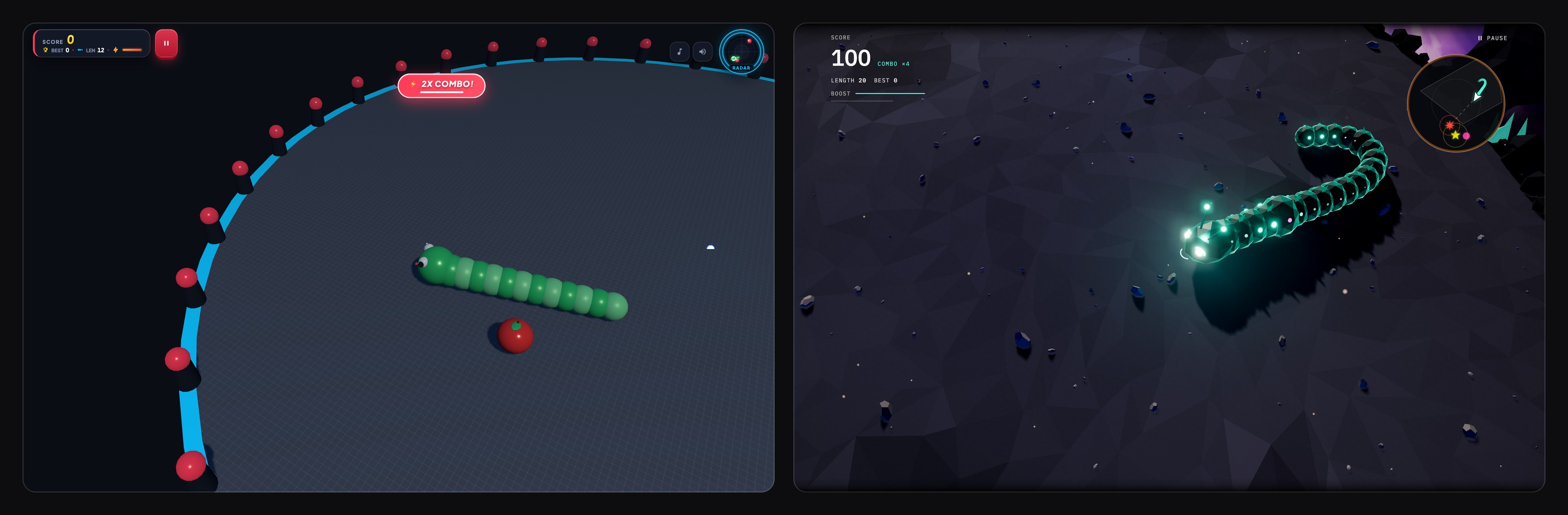
The full story · about 10 minutes
One question, three decisions.
Each decision opens with a short card: what I could have done, what I did, and what it cost. Read the cards for the argument, or keep going for the work behind each one.
Situation
Built for four keys
Perfect on a phone with buttons, and faked on everything since.
On a Nokia 3310, Snake was flawless. Four keys, 2, 4, 6 and 8, each with real travel and a click at the bottom. Your thumb knew where it was without looking, and a turn happened the instant you pressed.
Then phones lost their keys and Snake didn't adapt. It kept its square grid and its four directions, and every modern version I tried simulated the missing keys. In a game where one late turn ends the run, each simulation adds a tax.
Arrows on glass
Glass has no edges to feel. Your thumb drifts, lands between two arrows, and the turn never happens.
Swipes
Every turn is lift, flick, land. Slow, tiring at speed, and a diagonal flick is a coin toss.
A mouse on a grid
A mouse is made for pointing and gliding. Snapping it to four directions throws that away.
Problem
What makes Snake Snake?
Before changing anything, I wrote down what the game would still have to be without its grid.
- You eat to grow. Every success makes you longer.
- Your body becomes the maze. The longer you are, the less room you have.
- The walls close the space. There's a limit to how far you can run from yourself.
- Momentum is risk. You're always moving, and going faster makes everything harder.
None of the four rules needs a grid. The grid was how 1997 hardware expressed them, not one of them.
So the question became
If the input is continuous, shouldn't the game be continuous too?
Decision 1
Every input becomes one angle
- Could have
- A better virtual D-pad, or swipe controls, like every other modern Snake.
- Chose
- Translate every input into one target heading, and turn the worm toward it at a limited rate.
- Cost
- You can't reverse on the spot. A tight U-turn takes real space, on purpose.
The model
Don't ask which device. Ask which way.
A thumb on glass, a mouse pointer, two keys and an analog stick all describe the same thing: which way do you want to go. The first thing I built, before the snake looked like anything, was the layer that turns each of them into one angle.
The game listens for whatever you touch first and switches as you do: pick up a gamepad mid-run and it follows the stick. The turn limit is what keeps it Snake. If the worm could turn instantly you could always spin away from danger, and your body would stop being a maze.
Each hand
The gesture each device was already made for.
Touch
The stick appears where your thumb lands.
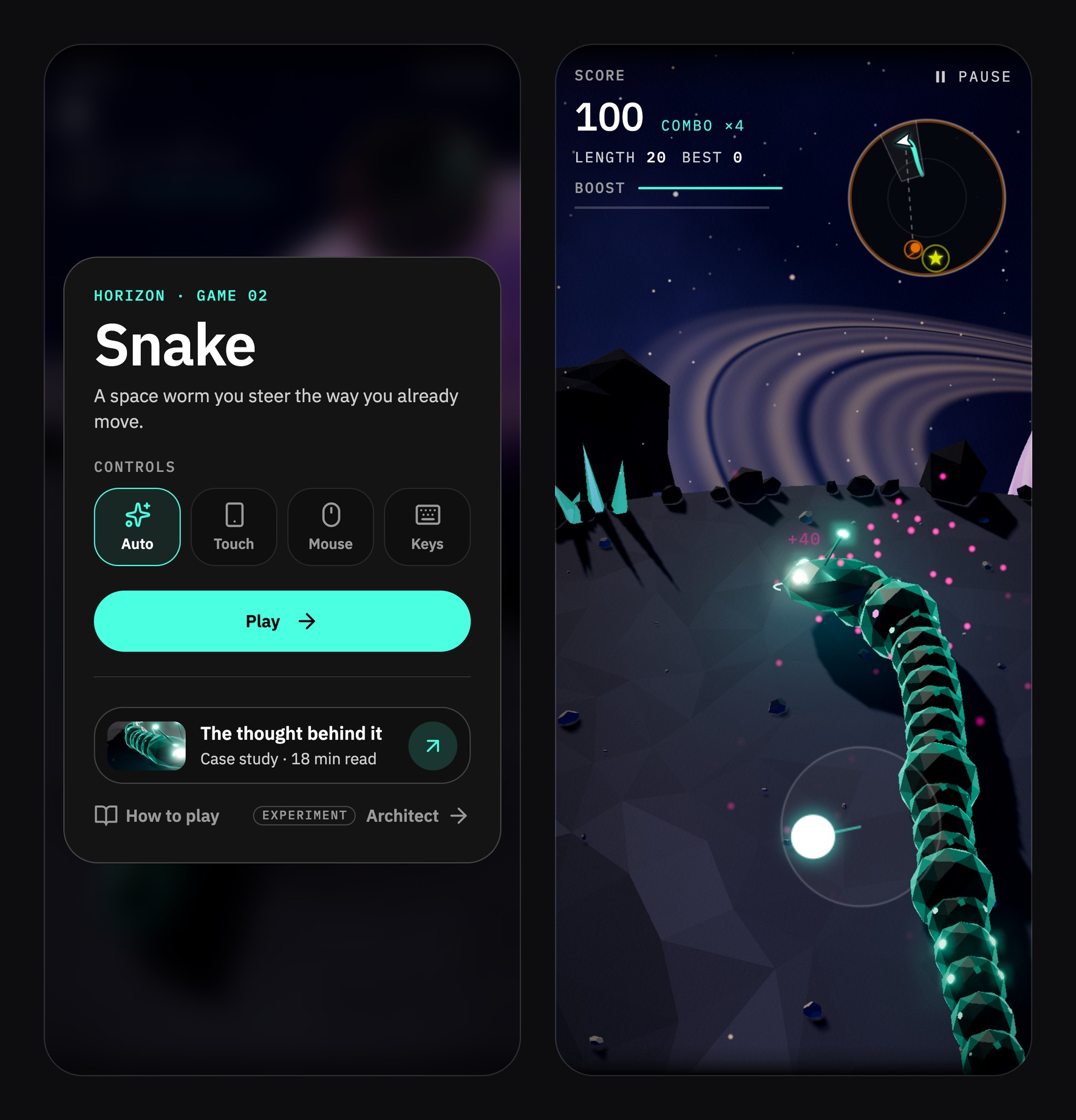
It's never under the wrong finger and never covers the game. A few pixels of drag steers, a second finger boosts, and a short vibration replaces the click the old keys gave you.
Mouse & trackpad
Point where you want to go.
The worm swims toward the pointer, with a small dead zone so it doesn't circle when you rest on its nose. Aim, don't click.
Keys
Lean, don't snap.
A and D, or the arrows, rotate the heading smoothly instead of jumping 90°. Holding carves an arc, tapping nudges. The one input that keeps a little of the old feel.
Gamepad
The stick is the heading.
The left stick points the worm directly, in any of 360°, and the controller rumbles when you eat or crash.
Decision 2
A camera to feel, a map to plan
- Could have
- The safe top-down view, which feels flat, or a camera behind the head, which hides your own tail.
- Chose
- A three-quarter chase camera for reflexes, paired with a 2D radar for strategy.
- Cost
- Two things to read at once, so the radar had to be readable in a blink.
The camera
High enough to plan, close enough to feel.
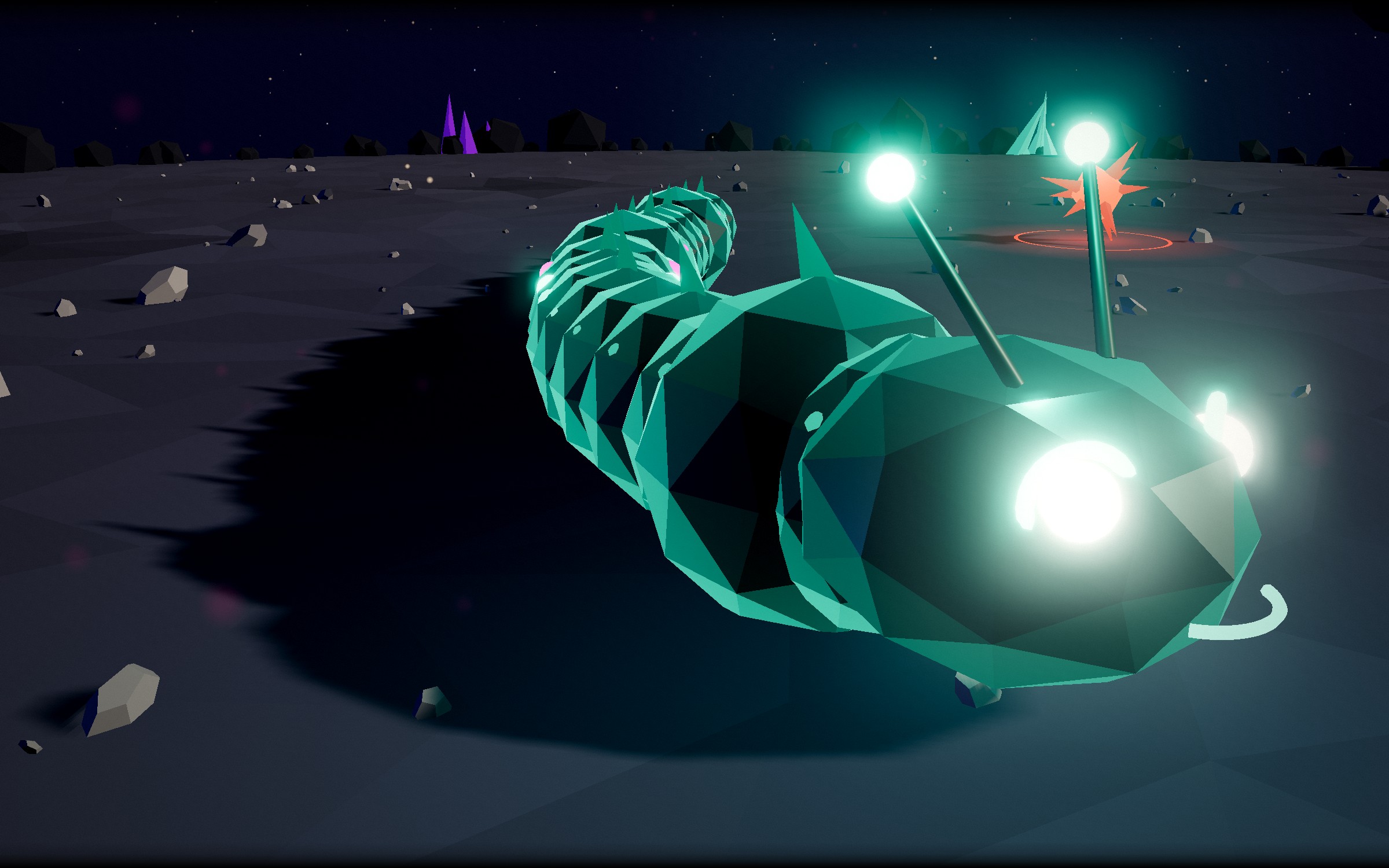
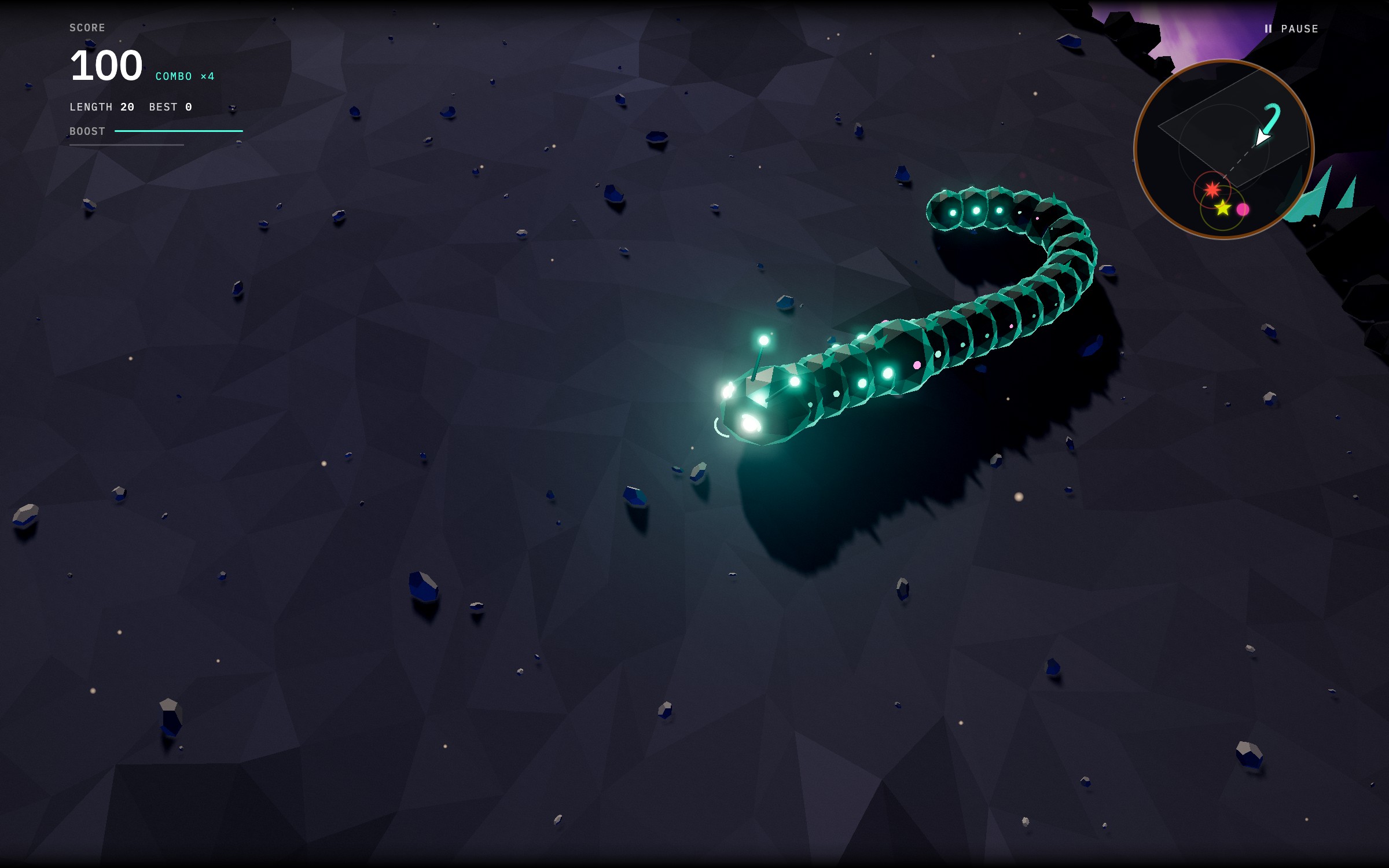
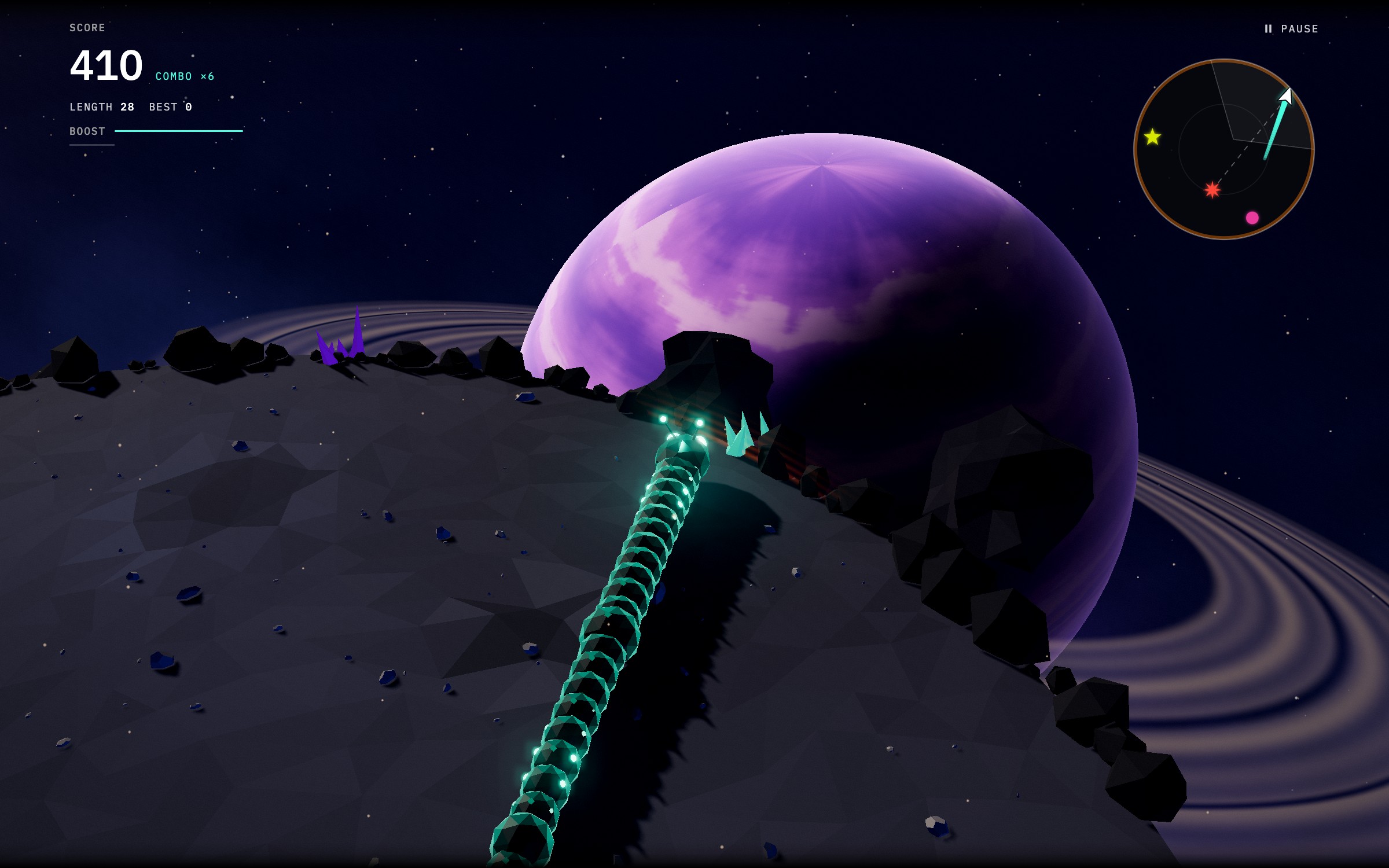
The camera floats high and behind the worm on a damped spring, so it lags a beat behind sharp turns and then catches up. It aims a little ahead of the nose, and widens slightly when you boost. The way the view leans and settles as you carve a turn is the moment the game stops feeling like a port. It's the one part I never changed.
The blind spot
3D gave the game depth, and took away the overview.
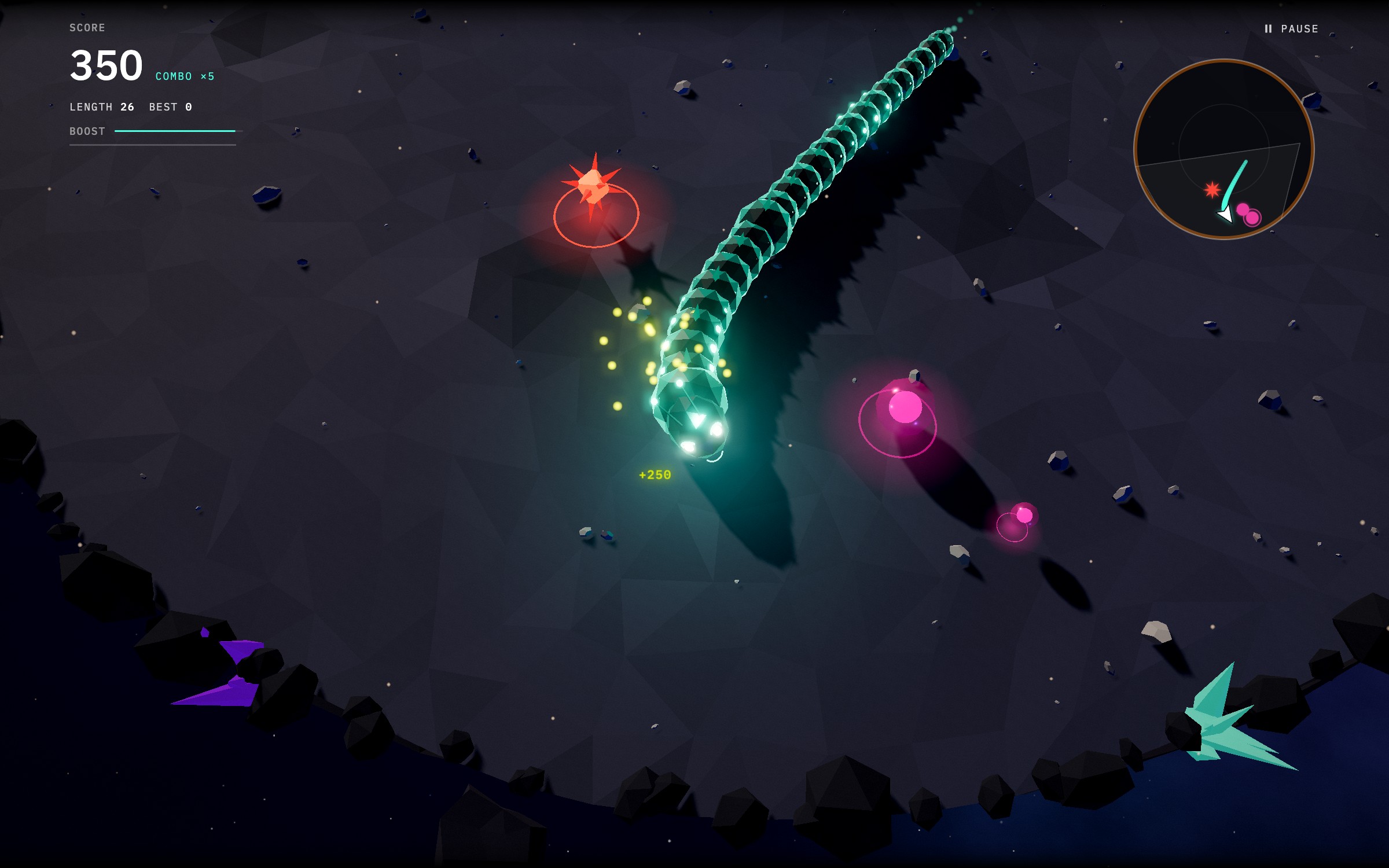
Classic Snake fits on one screen. With a chase camera, food can appear behind you and you'd never know, so early runs became wandering in search of the next meal. The 3D view now handles reflexes, and a radar handles where everything is.
The first radar was a small circle of coloured dots with a tiny wedge for a head. In play you couldn't tell which way you faced, and a glance cost more than it gave. So I rebuilt it around one test: can you read it in the time it takes to blink?
The radar, rebuilt
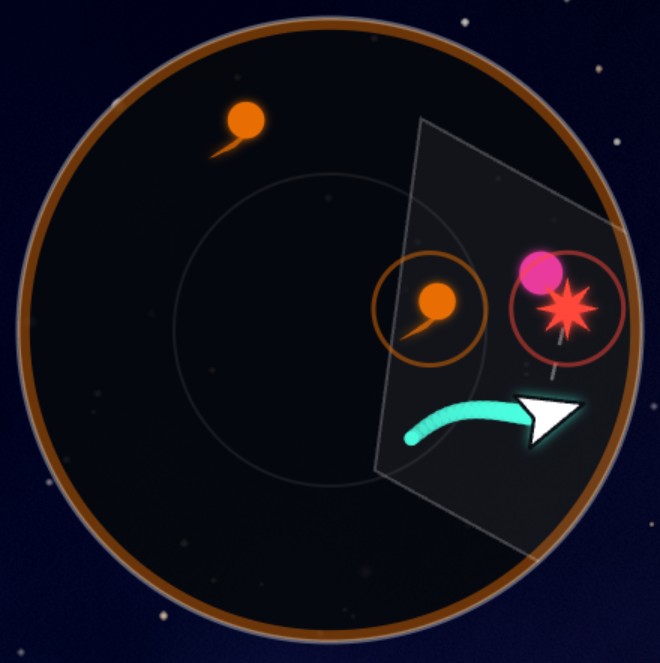
- Bigger, on a darker disc, with every mark scaled to match.
- A real arrowhead for the head, so direction reads instantly.
- Shape, not just colour: the same shapes as the items on the rock.
- What's on screen, drawn as a faint outline, so the map and the view connect.
- North is up, the way the camera faces, so turning on the map is turning on screen.
The items
Read it before you reach it.
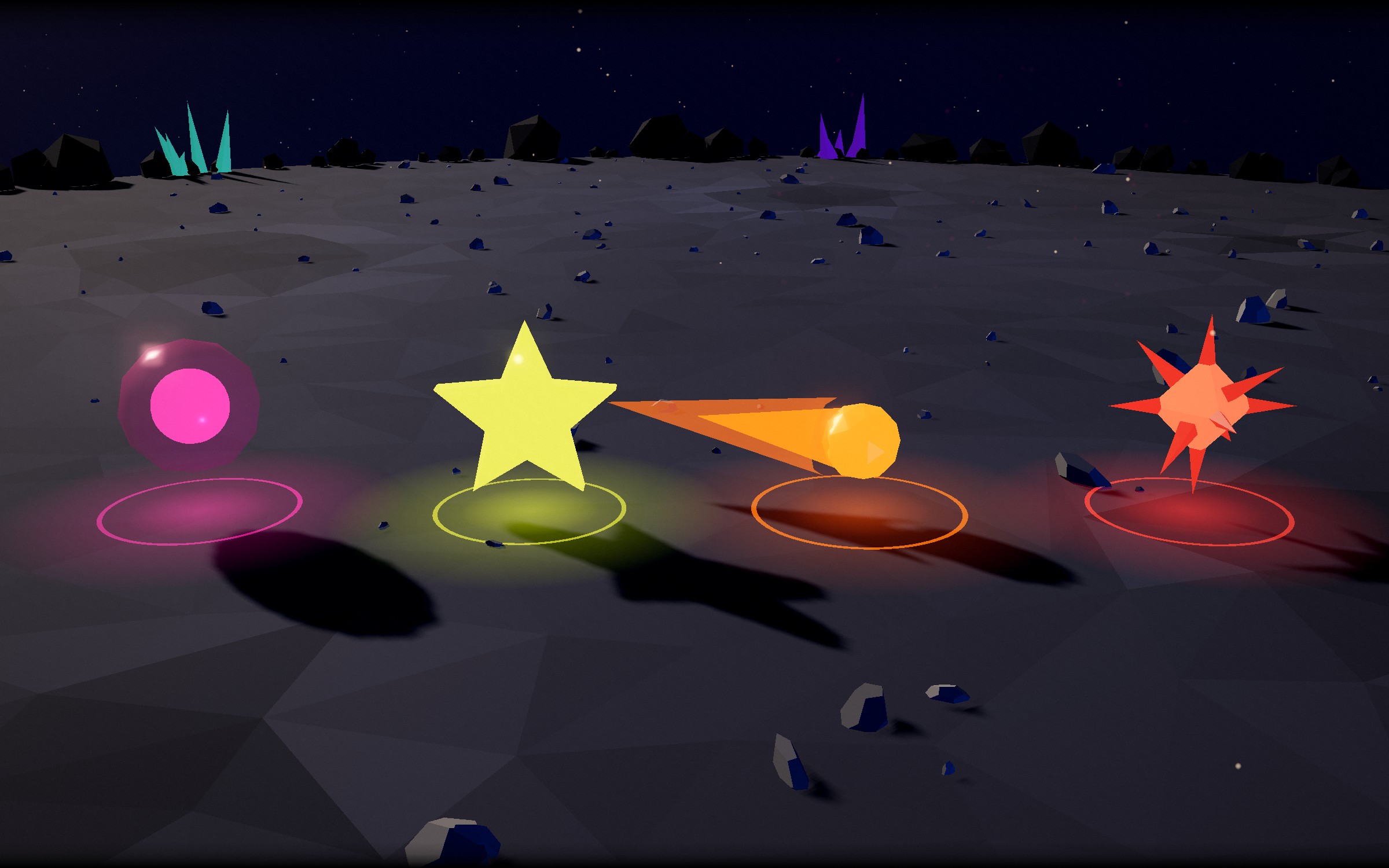
At speed there's no time to look anything up, so each item explains itself by shape: round is safe, a star is a prize, a tail means speed, spikes mean harm. The two in the middle give something and take something back, so going for them is a decision.
Decision 3
Direction before decoration
- Could have
- Kept the prototype's look: a bead snake on a disc, loud arcade menus and a glow on everything.
- Chose
- One written art direction, menus rebuilt in the site's design system, and sound synthesised live on the site's own sound switch.
- Cost
- My first space pass was scrapped entirely.
The world
My first pass looked cheap, so I wrote the direction down first.
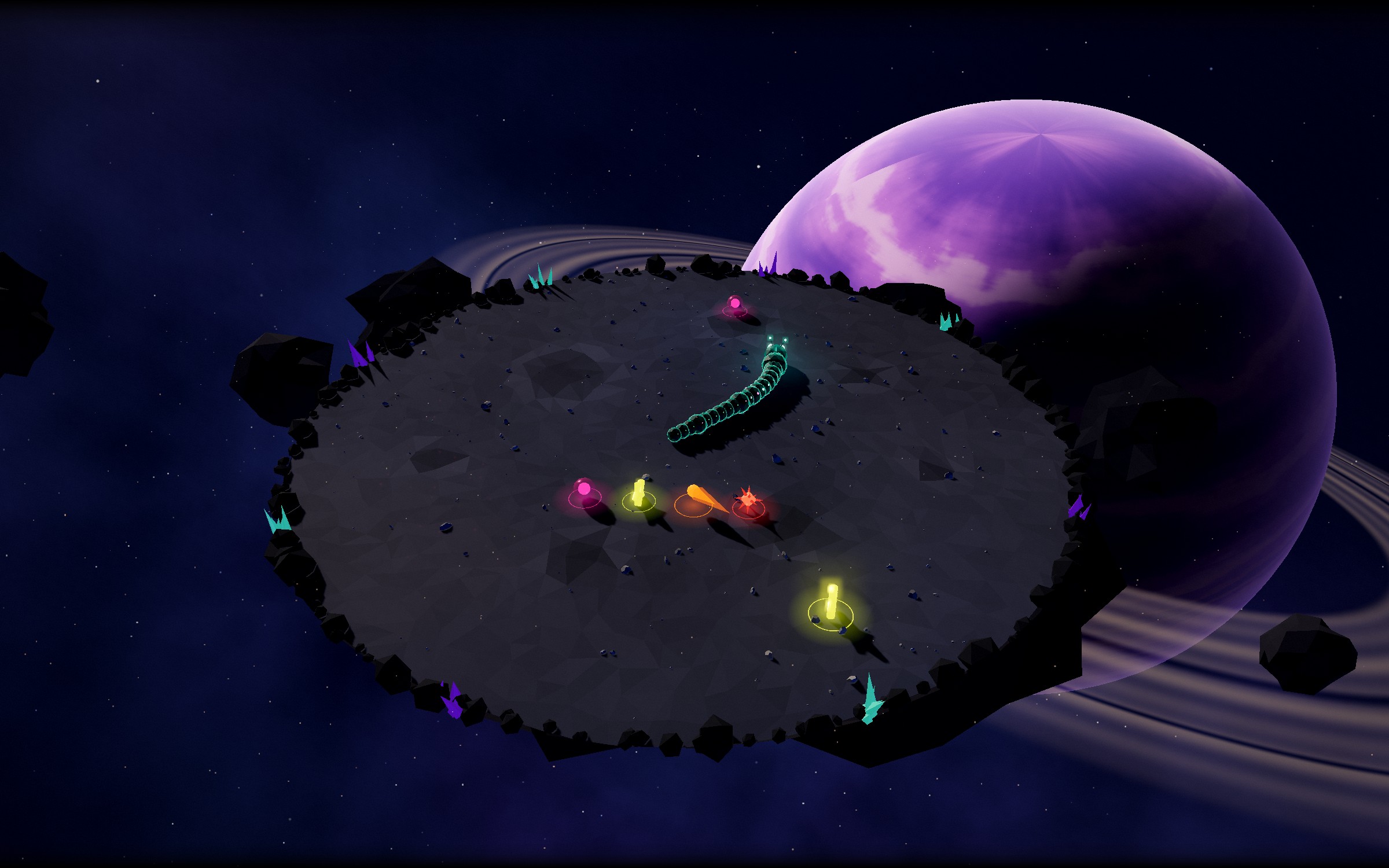
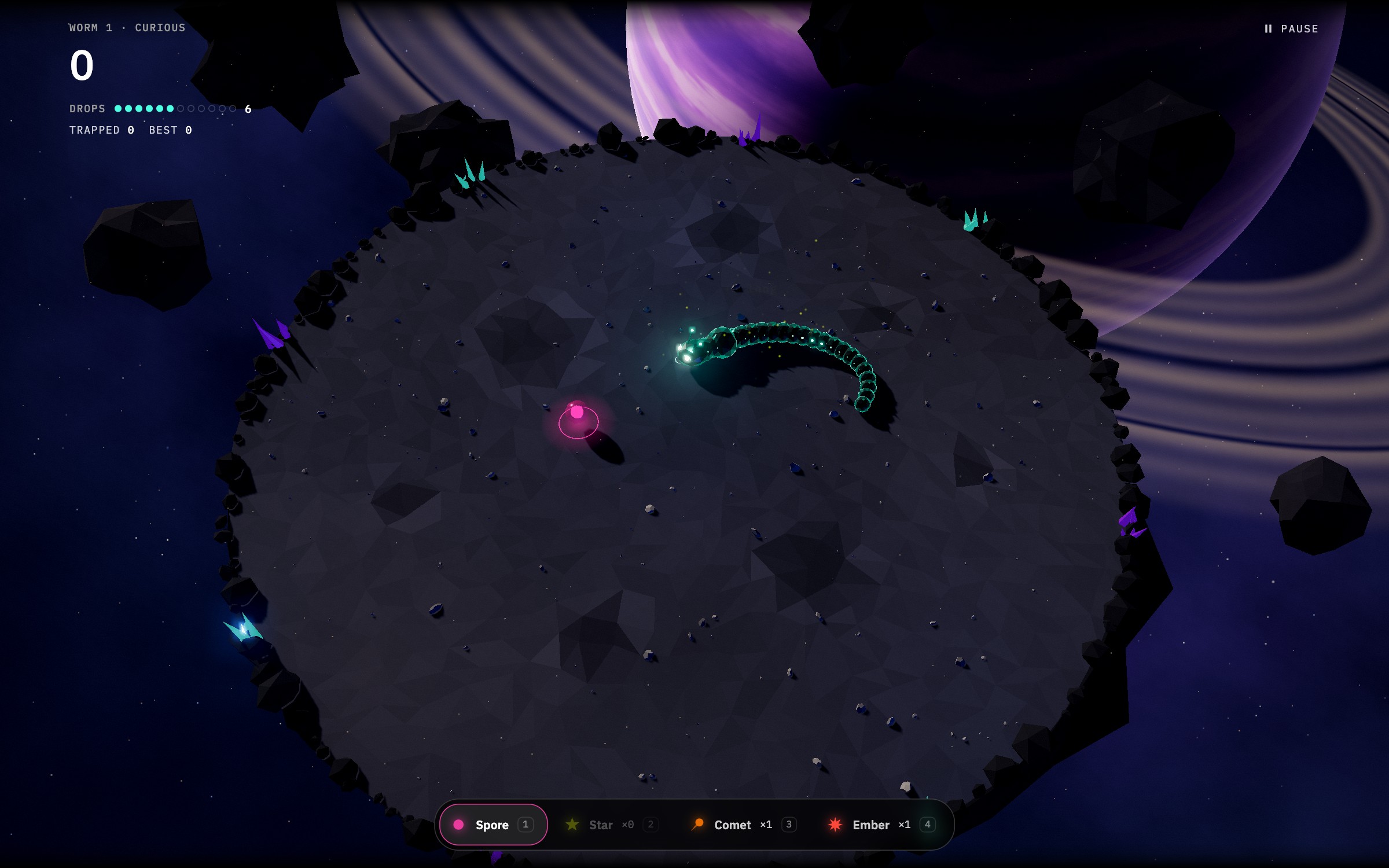
The first space theme was a neon ring on a black disc with heavy glow everywhere. Nothing told your eye where to look. The second time I started from one sentence: a flat-topped shard of rock adrift in deep space, lit by a low sun.
Light
A low sun and long shadows.
The worm's shadow stretches across the rock, which does more for reading depth than any effect.
The edge
The cliff is the boundary.
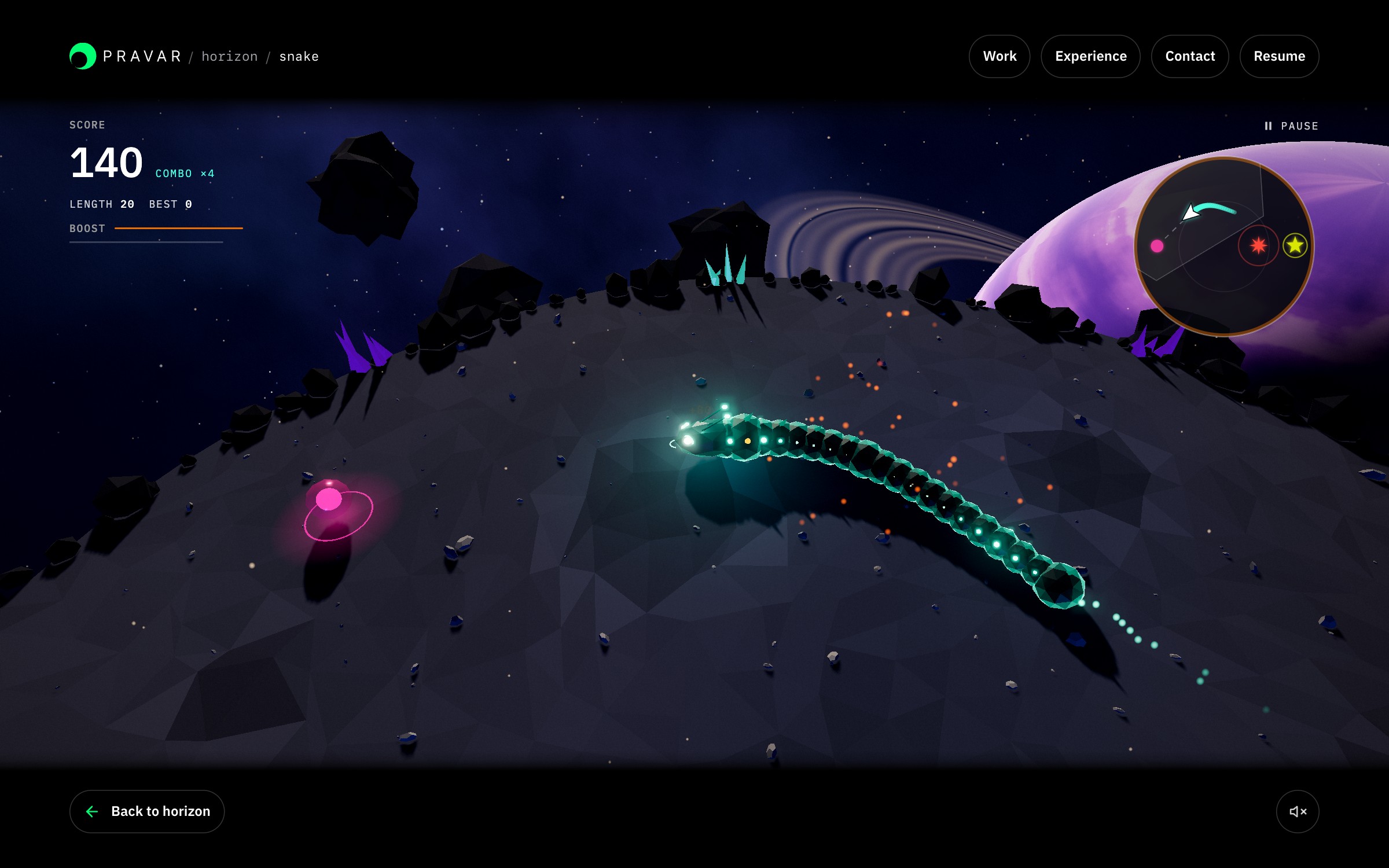
No wall to bounce off: a lip of boulders and nothing beyond. A warm shimmer and a low hum rise as you get close.
Scale
Something enormous behind you.
A ringed gas giant below the far edge. The arena feels small, and the world doesn't.
Colour
Only what matters glows.
The rock is grey. Colour is kept for the worm and the food, so your eye goes straight to them.
The interface
From an arcade cabinet to a quiet panel.
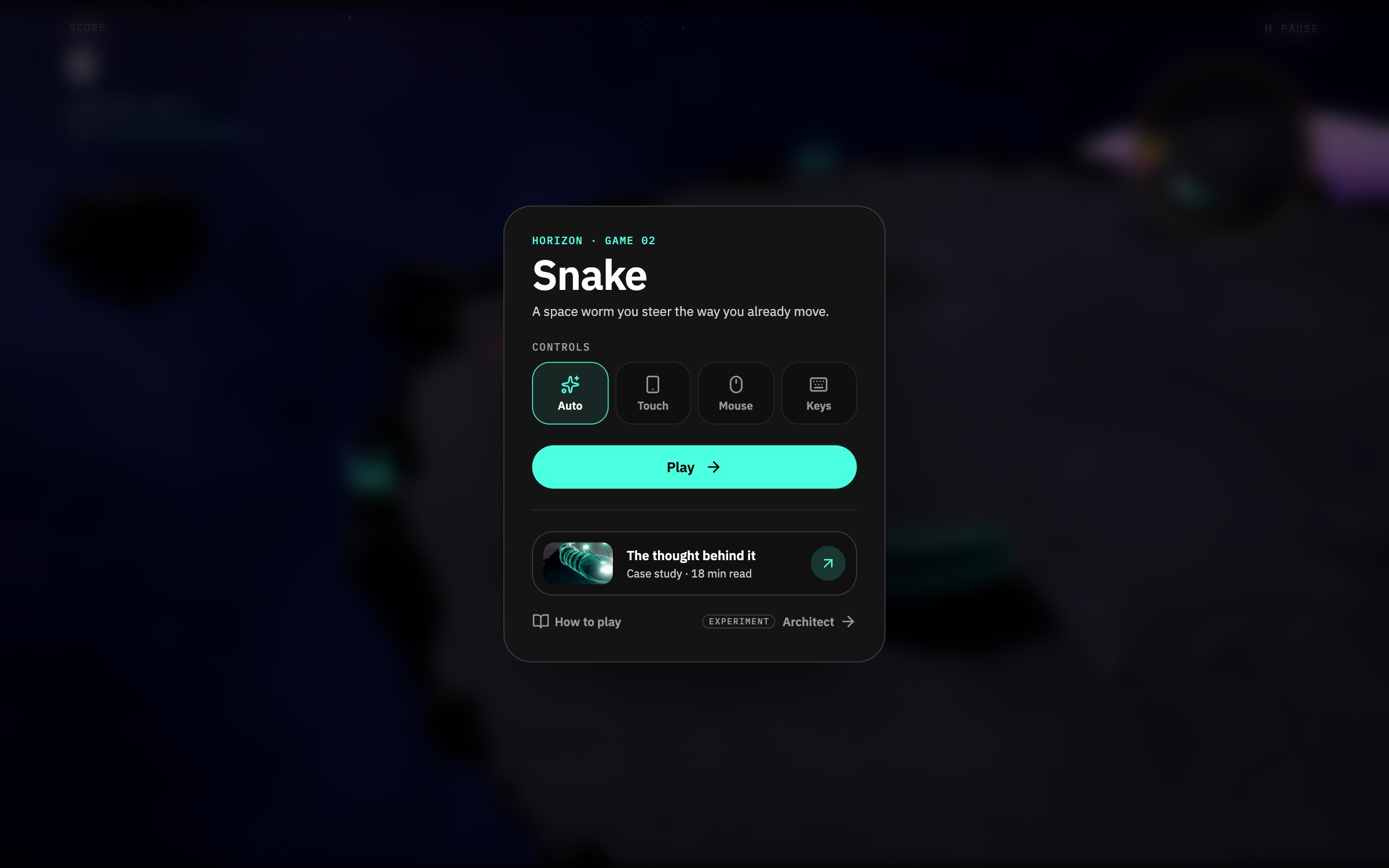
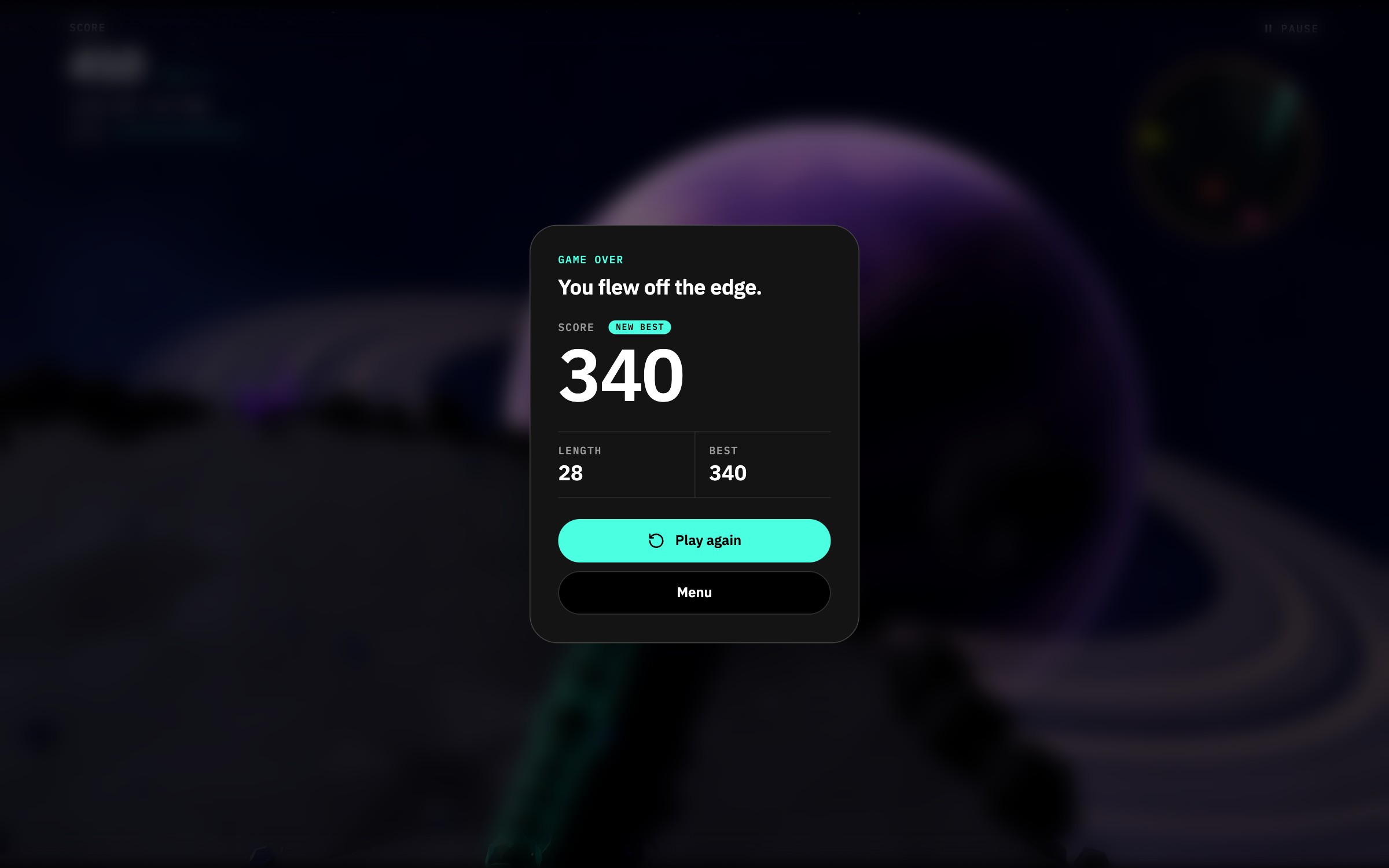
Every panel was rebuilt on the same card as the rest of this site: IBM Plex, mono labels, one accent colour. The start screen asks one question, how you steer, and offers Play. Items and rules wait one tap away in How to play, and a crash says what happened: you bit your own tail, or you flew off the edge.
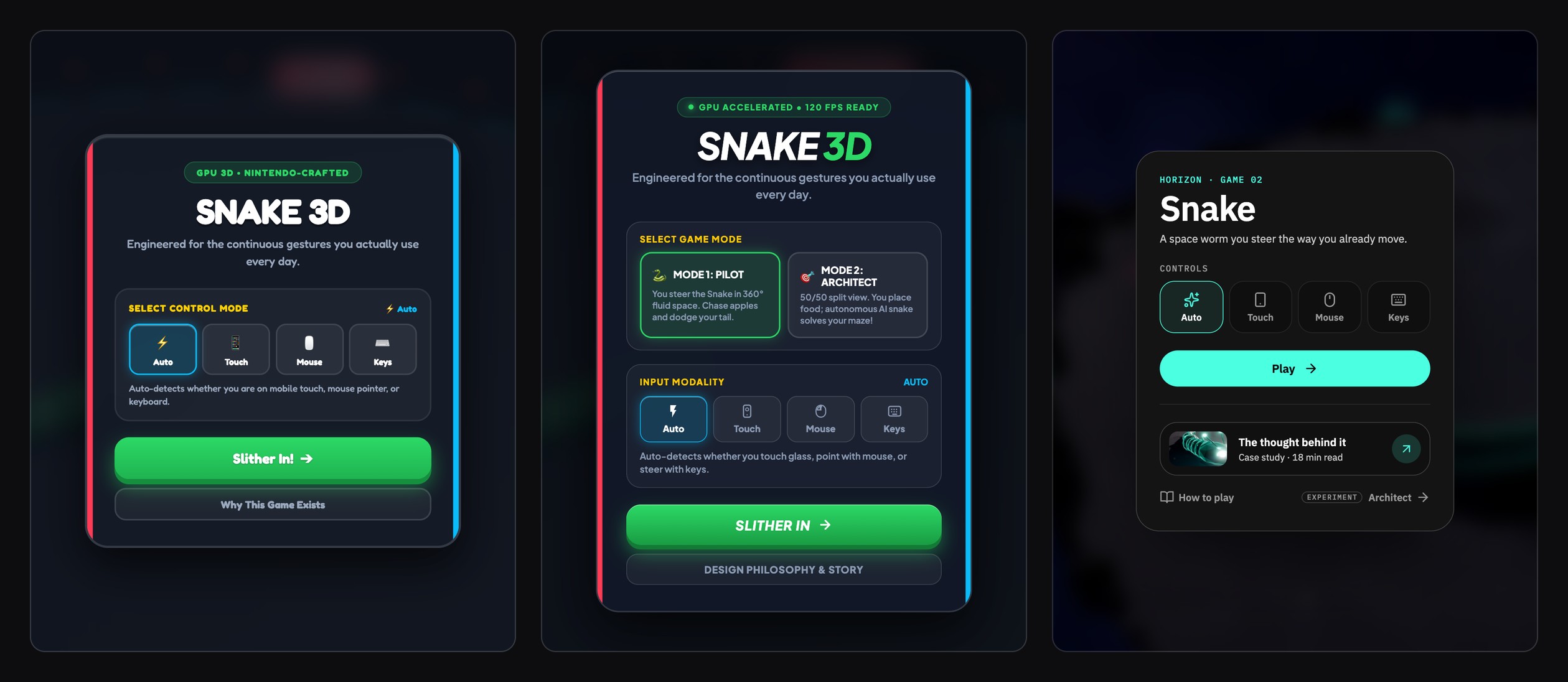
Sound
There isn't a single audio file in the game. A slow ambient bed gets busier as your combo builds, each meal is a glassy note that climbs the scale, boost is a breath of filtered noise, and a crash is a thump and a falling note. All of it follows the site's sound switch.
The game
As it plays today
Real runs, recorded from the game. To keep them steady, the game's own AI is steering.
A run in progress
In Horizon
Start
The edge
Game over
Reflection
What I'd take with me
What I learned
Design for the input, not the device.
Four devices became one question, “which way?”, and device detection became a detail. It's how I'd approach any product that has to work on whatever someone is holding. Writing down what the game was before touching it is what made that possible.
What's next
It hasn't been through structured playtesting yet. The next step is watching five people pick it up cold, on their own devices.
Still open
The questions it left
- Terrain. Would hills, ramps or tunnels deepen the steering, or ruin its purity?
- Other people. One heading per player is tiny to send over a network. Is the game better with friends in the same arena?
- The other side of the screen. In every Snake the game places the food and you react. What if you placed it, and the worm had to work out how to reach it?
That last one is a small experiment called Architect, tucked away at the foot of the start screen. I don't know yet whether it's a game, a toy or a dead end.
Closing
Snake was always about a body that becomes its own obstacle. Give it back to the hand you actually have, and it still works.
More work
-
 Lisa
AI Receptionist
An AI receptionist designed to make handing over the phone feel natural for small businesses.
View case study · 20 min
-
 Auto Attendant
Call Routing
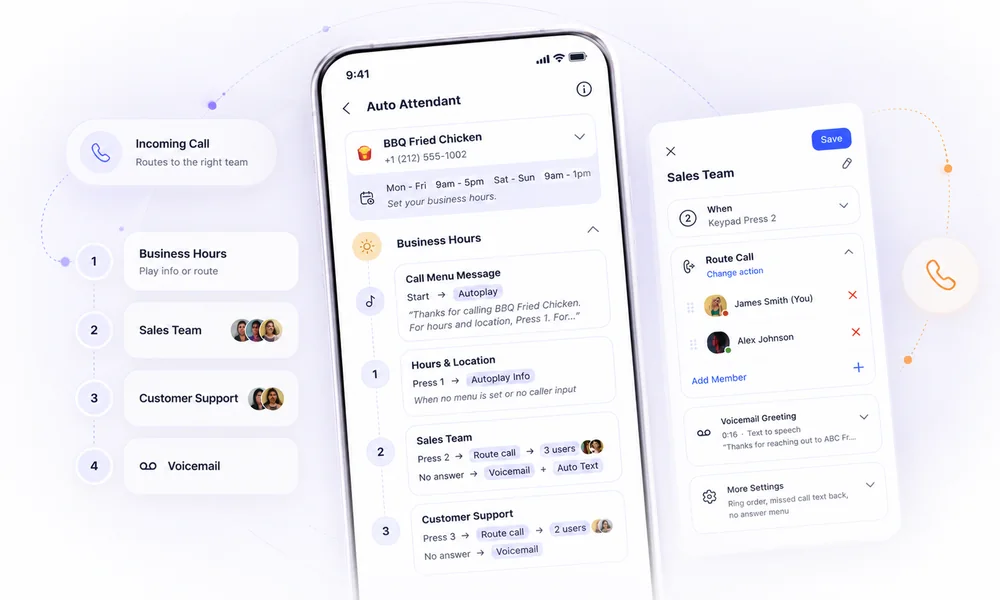
Call routing a small business could actually set up: one system where basic and advanced setup are the same screen at different depths.
View case study · 12 min
-
 Website Transformation
Design → Publishing
A 500+ page website moved to Framer and rebuilt around a new structure and content system, so design could publish.
View case study · 12 min
-
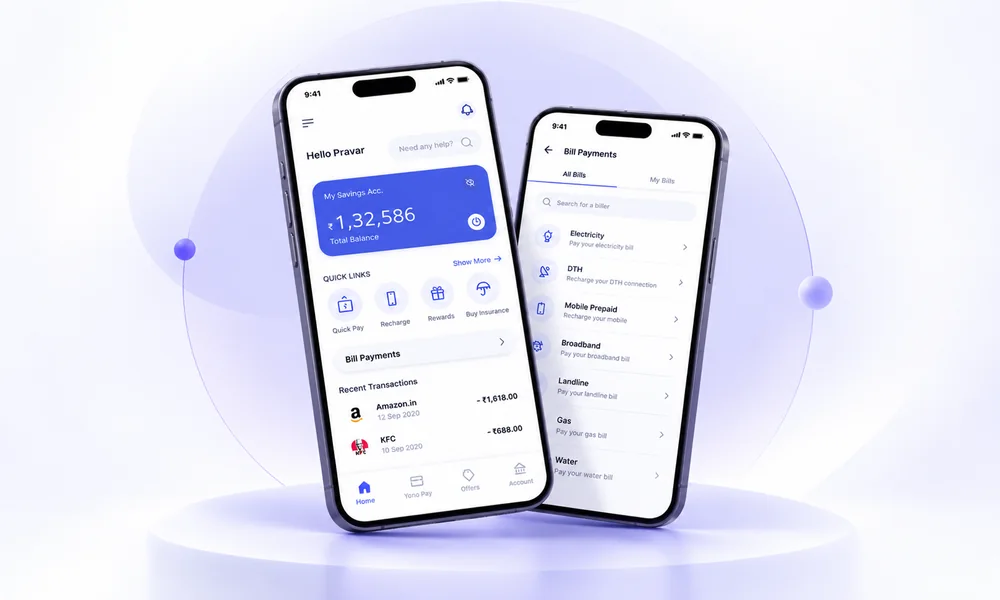 YONO by SBI
App Redesign Concept
A first-principles redesign exploring how mobile banking could become clearer and easier to use.
View case study · 20 min
-
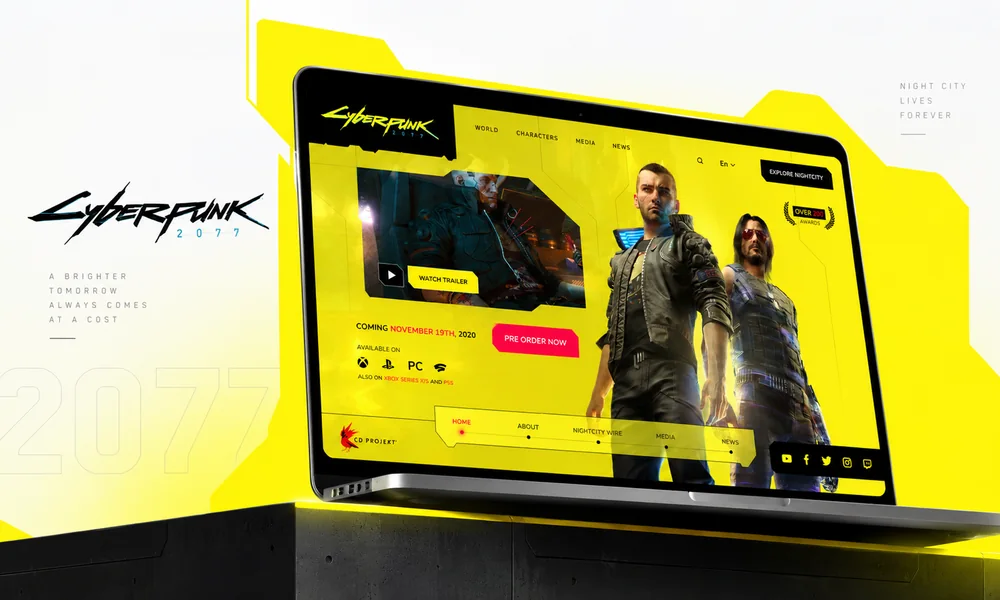 Cyberpunk 2077
Website Concept
A launch-website concept built around the game’s world, atmosphere and visual language.
View concept · 5 min